Service
3D Laser Scanning
Location
Calgary
Industry
Industrial & Manufacturing
Why Process Facilities Are a Scanning Problem
An operating oil and gas facility in Alberta is one of the least likely buildings in Canada to match its own drawings.
The reasons are structural to how these sites run. Plants are modified continuously rather than rebuilt: a line rerouted during a turnaround, a pump swapped for a different footprint, supports added, insulation changed, instrumentation relocated. Each change is individually small and individually sensible. Cumulatively, after fifteen or twenty years, the P&IDs describe a facility that is related to the one standing on site but is not identical to it.
That gap does not matter until someone has to put something new into the middle of it. Then it matters immediately.
Brownfield work is where this becomes expensive. A new skid, a replacement vessel, a rerouted line, a tie-in to existing pipework: all of these require knowing where the existing steel, pipe, cable tray and equipment actually are, not where the drawing set says they were intended to be. A fabricated spool that does not fit is not a drawing problem at that point. It is a crane, a crew, and a shutdown window.
What Scanning Captures in a Process Area
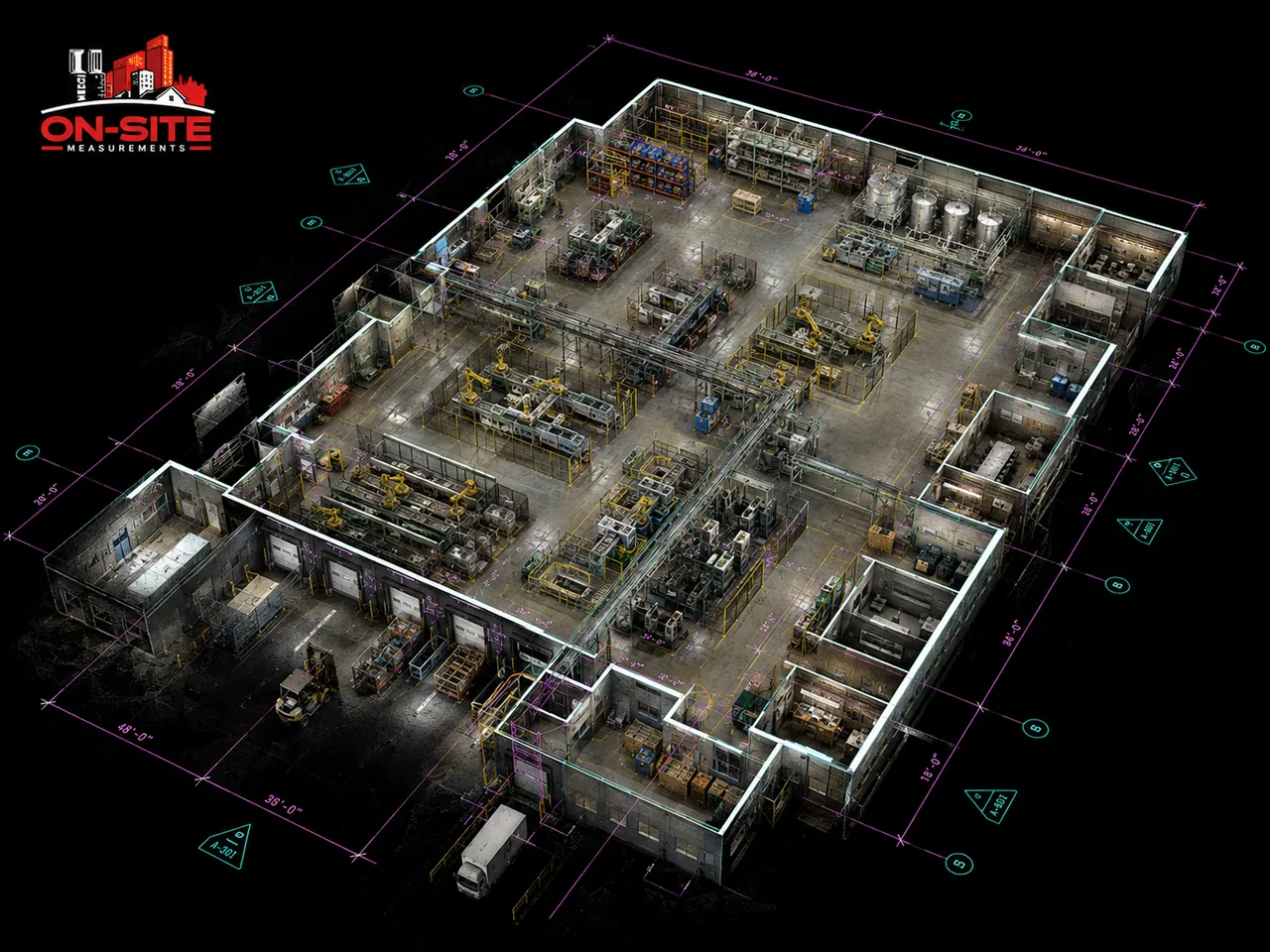
3D laser scanning records the visible condition of the plant as it stands. In a congested process area that means pipe runs and their supports, structural steel, vessels and equipment envelopes, valve and flange positions, cable tray and conduit routing, platform and access steel, and the clearances between all of it.
Congestion, which makes these areas difficult to measure by hand, is exactly what makes them suit scanning. A tape measure in a pipe rack gives you the dimensions somebody thought to take, from the positions they could physically reach. A scan records the whole volume from every setup position, including the geometry above head height and behind the first row of pipe, which is usually where the interference turns up.
Coverage planning matters more here than in most building work. A process area has to be captured from enough positions that the congestion does not shadow itself. Scanning a pipe rack from one side produces a point cloud with a solid front face and nothing behind it.
The Constraints That Shape an Alberta Site Visit
Technically this is not the hardest capture work. Operationally it is among the most constrained, and the plan reflects that more than it reflects the scanning.
Site access and escort. Operating facilities control who is on site and where. Access is arranged in advance, escorts are commonly required, and the work happens on the operator's schedule.
Safety orientation and PPE. Site-specific orientation before entry is standard. Crews work to the facility's requirements, not their own.
Hazardous area classification. Classified areas govern what equipment may be brought in and where. Equipment selection and the areas that can be captured are confirmed with the operator before mobilisation rather than negotiated at the gate.
Turnaround and shutdown windows. Some areas are only accessible during a planned outage. Those windows are fixed, short, and shared with every other trade needing the same access. Capture planned into a turnaround has to be sequenced with everyone else working that window.
Weather. Alberta winters affect outdoor work at process facilities. Scheduling allows for it.
None of that is scanning difficulty. It is the reason a plant scan is planned weeks ahead rather than booked for next Tuesday.
Deliverables for Brownfield Work
What gets produced depends on what the project feeds.
| Deliverable | Used for |
|---|---|
| Registered point cloud (E57, RCP) | Design reference, clearance checking, measurement of anything not modelled |
| Existing-condition 3D model | Design of new work against the current plant, in the team's own environment |
| Measured drawings and sections | Layouts, general arrangements, and coordination for teams working in 2D |
| Extracted dimensions and clearances | Specific queries answered against the captured data |
The point cloud is worth retaining regardless of what else is produced. A model is built to a scope agreed at the start of a project. The cloud holds everything that was visible on the day, and on a facility that will be modified again in three years, that record has a longer life than the project that paid for it.
Where It Stops
Worth being plain about the boundaries, because process work attracts assumptions.
Line of sight only. Scanning records visible surfaces. Anything inside insulation, buried, inside a vessel, or otherwise concealed is not captured. Where a project depends on knowing what is under insulation, that is a separate investigation.
Not an inspection. A scan records geometry, not condition. It does not assess corrosion, wall thickness, integrity, or fitness for service.
Not engineering. Existing-condition models and drawings are a design reference. On-Site Measurements does not provide engineering sign off, stamped drawings, or code assessment. The measured record supports the responsible engineer's work; it does not replace it.
Accuracy varies by setup. Scanner, registration method, coverage and site conditions all affect what a capture resolves. We agree the approach and the intended use before starting rather than publishing a single figure that would not hold across every project.
Scoping a Facility Scan
Useful to have ready when requesting a quote:
- Facility location and the operator's site access process
- The area or units in scope, with a plot plan or area drawing if available
- Whether capture must fall inside a turnaround window, and the dates
- Hazardous area classification for the areas involved
- Required deliverable: point cloud only, model, drawings, or a combination
- The downstream software the deliverable has to open in
- Safety orientation and escort requirements
Related Services
- 3D Laser Scanning: capture for congested industrial and process environments
- Scan to BIM: existing-condition models built from plant scan data
- CAD Drafting: measured 2D drawings and layouts
- Industrial and Manufacturing: how we support facility and plant teams
For a facility near Calgary or elsewhere in Alberta, send the area in scope, the access requirements, and the turnaround window if there is one. Request a quote and we will come back with a capture plan built around the site's constraints.